
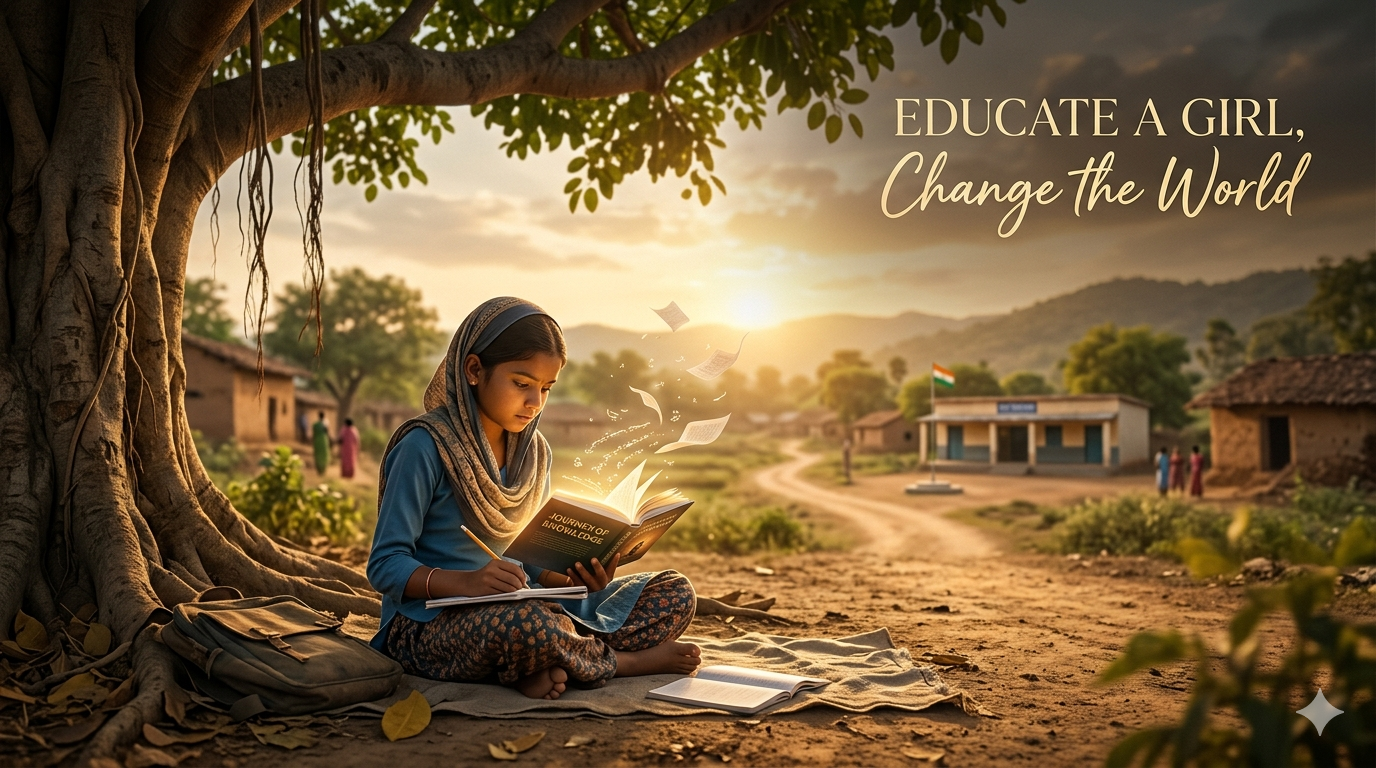
In a small village surrounded by dusty roads and golden fields, there lived a young girl named Amina. She had big, curious eyes and a heart full of dreams. Every morning, as the sun painted the sky in shades of orange, Amina would stand outside her mud house and watch children walk to school with books in their hands and laughter in the air.
But Amina was not one of them.
In her village, girls were not encouraged to go to school. “Education is for boys,” people often said. “Girls belong in the home.” Her father, a hardworking farmer, believed the same. He loved Amina deeply, but he feared society more than he believed in her dreams.
Still, Amina had a secret.
Every day, she would sit near the window when her younger brother studied his lessons. She would quietly listen, memorizing letters and numbers. At night, when everyone slept, she would trace alphabets in the dust with her finger, whispering them like precious treasures.
One evening, as her brother struggled with his homework, Amina softly said, “That word is ‘beautiful.’ It means something very nice.”
Her brother looked at her in surprise. “How do you know that?”
Amina smiled shyly, “I just listen.”
Her father, who had been resting nearby, overheard the conversation. He was shocked. “You know how to read?” he asked.
Amina lowered her gaze. “A little… I want to learn more, Abba.”
Her father remained silent. That night, he could not sleep. He kept thinking about his daughter—how she had learned without a teacher, without books, without permission.
The next morning, Amina saw a new teacher arrive in the village. Her name was Miss Sara. She had come from the city with a mission: to educate every child, especially girls.
Miss Sara went door to door, speaking to families. When she reached Amina’s house, she gently said, “Every girl deserves an education. When you educate a girl, you educate a whole generation.”
Amina stood behind the curtain, her heart beating fast.
Her father hesitated. “People will talk,” he said.
Miss Sara smiled kindly. “Let them talk today. Tomorrow, they will thank you.”
Days passed, and Amina’s desire to study grew stronger. She would watch Miss Sara teaching under a tree, her eyes filled with longing.
One day, Amina gathered all her courage and said to her father, “Abba, please let me go to school. I promise I will still help at home. I just want a chance.”
Her father looked at her—really looked at her—for the first time. He saw not just a daughter, but a spark, a future, a light waiting to shine.
Finally, he said, “Alright, Amina. You can go.”
Amina couldn’t believe her ears. Her heart leaped with joy. The next morning, she wore her simple dress, held a small notebook Miss Sara had given her, and walked proudly to class.
From that day on, everything changed.
Amina was a quick learner. She absorbed knowledge like dry soil drinks rain. She asked questions, read books, and helped other children understand difficult lessons.
Soon, she became the best student in the class.
But her journey was not easy.
Some villagers mocked her. “Why educate a girl?” they said. “She will just get married.”
Amina would hear them, but she never stopped. Instead, she worked harder.
Years passed, and Amina continued her studies. With Miss Sara’s guidance, she earned a scholarship to study in the city. It was the first time anyone from her village, especially a girl, had achieved something so big.
Before leaving, she hugged her father and said, “I will come back and make you proud.”
Her father’s eyes filled with tears. “You already have.”
In the city, Amina faced new challenges—language barriers, advanced studies, and a completely different environment. But she remembered her village, her struggles, and her dreams. She stayed strong.
She studied day and night, determined to succeed.
After many years of hard work, Amina became a doctor.
But she didn’t forget her promise.
She returned to her village—not as a helpless girl, but as a strong, educated woman. She opened a small clinic and started teaching girls in the evenings.
The same villagers who once doubted her now respected her. Parents began sending their daughters to school. The village slowly transformed.
One day, Amina stood under the same tree where Miss Sara once taught and said to a group of young girls, “Education is not just a right—it is your power. Never let anyone take it away from you.”
Her father stood in the crowd, smiling with pride.
And Miss Sara, who had returned to visit, whispered, “This is why we educate girls.”
Moral of the Story 🌟:
Educating a girl is not just about teaching one individual—it is about empowering families, transforming communities, and building a brighter future for generations to come. When girls are given the chance to learn, they don’t just change their own lives—they change the world.